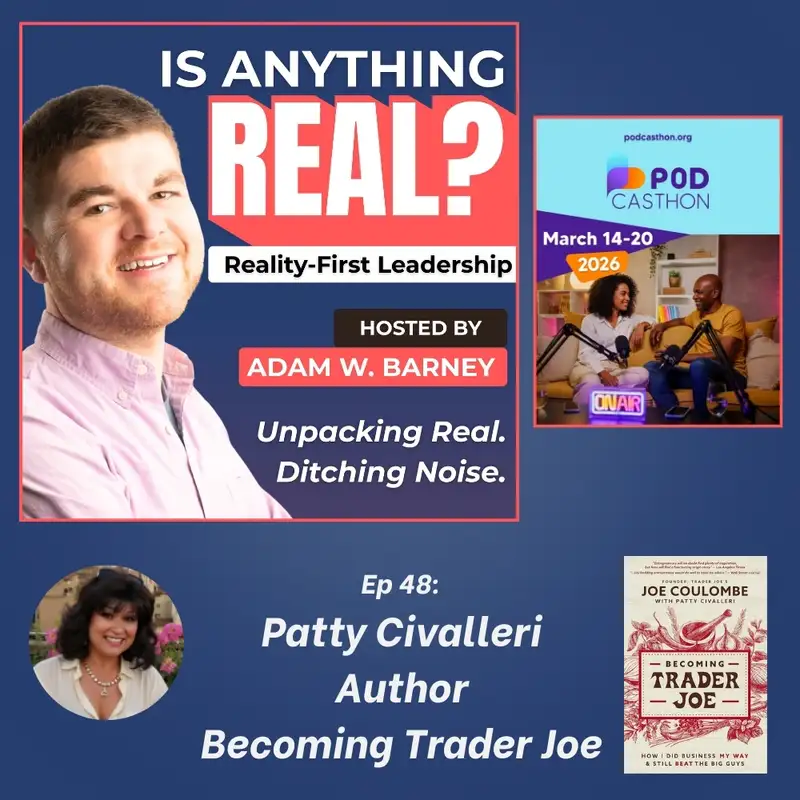
Trader Joe’s Truth: Differentiation, Culture & Leadership | Ep. 48 w/ Patty Civalleri
[00:37.6]
This episode is part of Podcasthon Week. Podcasters around the world dropping special episodes to spotlight a nonprofit and today, we're supporting the ACLU. But here's the uncomfortable truth: Most iconic brands are basically mythology factories.
[00:54.9]
People repeat stories they want to be true and call it strategy. Today's guest wrote the book a lot of Trader Joe's internet experts are quietly copying because, there's so little real stuff out there. So we're doing this reality-first.
[01:11.4]
What's myth, what's real, and what leaders can actually steal from the Trader Joe's playbook without cosplay. Welcome back to "Is Anything Real?", the Reality-First Leadership show, where we separate proof from performance. I'm Adam W. Barney, and I care less about what sounds smart and more about what holds up in real life.
[01:30.4]
Today's guest is Patty Civallari, author of "Becoming Trader Joe". She's also lived a life that makes most LinkedIn thought leaders look like they've never left the airport. Her background is in history and archaeology, traveling the world with scientists and researchers in search of lost and ancient cultures.
[01:49.0]
And she even has a talk called "Indiana Jones In High Heels". And then she writes a book about one of the most beloved, least traditionally advertised brands in America. And suddenly, new podcast sites and hot takes start popping up that are basically quoting her.
[02:06.0]
Patty, welcome. Let's go myth hunting. Hi. Hi, Adam. So nice to meet you and so nice to be here today. Thank you so much for having me. I'm excited. All right, Patty, reality check. Trader Joe's is one of those companies where people act like they have insider knowledge.
[02:23.6]
Most of it is actually fan fiction. What's the biggest myth people believe about Trader Joe's success that you uncovered? Oh, wow. Let's see. There's all kinds. Let's see. First of all, there's no such thing as a real Joe. I've heard that one a lot, that he was just a made-up person.
[02:41.9]
But, if you look at the cover of my book, this book is actually taken from Joe's journals, with Joe. So the book is actually authored by Joe with me. I'm his co-author. Because he wasn't an author and a writer, so he didn't know how to turn his journals into his real story.
[03:00.5]
So, yes, indeed. I knew Joe for over 30 years. And he was a really great guy and definitely a real person. So that's a pity. That's fantastic. I mean, what do you think people here on the east coast, where I am, get the most wrong about Trader Joe?
[03:20.3]
Oh, boy. Let's see, all kinds of things. Let's see. That it was founded by a German company. It was not. It was founded by Joe in California, who was born and raised in California and graduated from Stanford.
[03:40.3]
And, let's see. That's kind of a biggie. It's the confusion between the German-owned Aldi company, and there's a lot of confusion about how that has settled in. Yep. Okay. All right. I actually think that probably makes you laugh because it's delivered so confidently, but yet it's still so wrong. Right.
[04:01.3]
I have to think as a business owner, you know, if your strategy can't survive contact with facts, it's not strategy, it's just storytelling. Yeah, but you know, the company, has always even, you know, during Joe's time, you know, Joe kept everything close to the vest.
[04:22.0]
It is a private company. It needs to be respected for its privacy. But that doesn't stop people from talking, right? Right, right. What pulled you, though, into telling that real story, especially with how they do keep things close to the vest? Well, I was writing, you know, I was involved in the travel industry, writing historical travel books for Italy, for people that want to go quite a bit deeper than a typical tourist.
[04:48.7]
And then Covid hit and travel went from a $17 trillion industry to zip in a week. So needless to say, I was out of work. Like many. Like many. And so that was when some mutual friends approached me and said, Patty, Joe's got his journals, and he would like to figure out how to turn this into a book and see if it can get published.
[05:14.9]
Would you be interested? And I said, well, you know, that's not really my genre. And they said, so? I said, okay,
[05:25.6]
and had so much fun doing it. That's great. Absolutely. You also told me something that I absolutely love. After publishing, you mentioned that all these websites and podcasts started popping up and a lot of them are basically built on your book.
[05:43.3]
What do you think that reveals about the hunger people have? No, Trader Joe's pun intended. For real leadership examples? That was very good. I saw what you did there.
[05:55.4]
Yes, there truly is. Because Trader Joe's has grown into America's sweetheart grocer. And people love going there. You know, I did something a few years ago, that had to do with companies where people really look forward to them.
[06:17.8]
I mean, it's a real occasion. And Trader Joe's is one of those. Of course, Disney is one of those. You know, what is it that's different about some of these companies, you know, that do things so differently? And so it was my job to identify what they were doing differently and come up with some real reasons about how to bottle that and sell it. Right.
[06:40.8]
That's what they wanted to do, the people that hired me for that. So, yeah, I think you're right, though. People, they don't have the story, so make them up. Well, I think your example here of this book, though, is a master class in the fact that when information is scarce, that myths multiply.
[07:01.5]
Right. And that's what happened for decades. Yes. And I think that, you know, in our life now, we're living probably in the apex of the conspiracist era. Right. For the same reason, people don't know a lot of stuff, and so they just opine, and they make it up, and they connect their own dots, their own way and it doesn't always equal the truth.
[07:25.7]
You know, we're living with that every day now in a very big way in so many levels. Yeah, yeah. Let's take Trader Joe's, though, and turn it into a little bit of an operator lesson, right, for our listeners today. What constraints actually shape the leadership philosophy in building the company and what was true about the market, the customer, and the moment in time.
[07:45.6]
You know, what did Joe see clearly in building it there? Oh, boy. Okay, let's unpack all those. A whole bunch of different questions. Let's see if I can break that down in 10 words or less. No. You got it.
[08:03.2]
Let's see. Well, first of all, Joe did things differently because he saw the world differently. He was left-handed in a time when being left-handed was not acceptable in a very large way. So he enjoyed hiring people that were left-handed.
[08:21.9]
And because he wasn't legally allowed to ask them if they were left-handed, or he actually wasn't sure if he was allowed to ask them if they were left-handed, he would, you know, during their interview, if he really liked them, he'd ask them to write something down. And that let him know, you know, it's kind of his little secret way of getting people that saw the world differently.
[08:41.1]
He didn't want yes-people around him. He wanted oeople that did see the world differently. The reason why is because the grocery industry back then, when Joe started, was so regulated in so many ways. As an example, if you wanted to carry cheese, if he was going to carry cheese or any dairy product, as an example, or eggs, you know, the eggs had to be, you know, this size.
[09:04.8]
They had to be packaged in boxes of 12, and they had to be within a certain very small window of pricing. Cheese had to be packed in that 1-inch thick block of cheddar cheese that you see. Right. That was regulation. Right.
[09:21.0]
Milk. The whole dairy industry was very regulated. And so he didn't want to carry anything that was regulated. Because why would people come to him if they can just go to their friendly neighborhood grocer? So he wanted to carry everything in a store to be different.
[09:37.1]
But, but his customers wanted cheese and eggs and milk, saying Joel, if I'm going to come here for different things while I'm here, I want to pick up my basics. He said no. So he did funny things. For instance, he figured out how to make his products different. So, as an example, eggs.
[09:55.1]
How do you make an egg different? Right? Right. He found a farmer, a California farmer that carried different kinds of eggs. And he said, wow, nobody carries these. There's not enough to supply the entire grocery industry, but there's enough to supply me. Yeah, I think I'll do these.
[10:12.0]
What do you suppose was different about these eggs? Were they square? They were brown? No, they weren't brown. Although eventually they were. But they weren't square either. So they were... are you ready for this?
[10:28.3]
Extra large. They were extra large. And he found, because he was buying them direct from the farmer, that he didn't have a middleman. So he could sell extra-large eggs for the same amount that all the grocery stores were selling medium eggs for.
[10:43.8]
So he gave you something that was really important to him, and that's value. Value for your money. So he felt that everything had to. He built his four pillars of differentiators. And those differentiators, every product had to meet at least three of the pillars.
[11:03.0]
And the four pillars were: Price. Obviously, you can do things based on price, but for him, price meant value. So it wasn't that his eggs were any cheaper than anybody else's, but you got more egg. And another was packaging or quantity.
[11:22.0]
Packaging. Well, it did mean that eventually he started private labeling a lot of his products. But it also meant that instead of 50-pound bags of rice that, that they carried all through the 20th century, he was going to put them in smaller packages because he saw that people were now moving into apartments and the apartment boom was booming back then, and they didn't have space to store large things.
[11:47.2]
So a lot of those flour, rice, things like that, that were sold in very large packages, he would sell in apartment-size packages. The third pillar was ingredients. To Joe, it meant health benefits.
[12:04.7]
Because back then was the Monsanto era, where they were injecting everything with hormones and just all kinds of preservatives and stuff. And he said, no, I'm going back to the farm. And back then, everybody was coming away from the farm, and they were going to science. He said, no, I'm going to go back to the farm.
[12:21.8]
Remember, he's trying to make his store different than everybody else's. And the fourth was uniqueness or rarity, which he found by sending his buyers around the world. So, things like cheese.
[12:40.2]
He sent his buyers off to France, and they brought back something that America fell in love with. And now it's a staple. Free. Right? So we found out the American government couldn't regulate foreign products. They can only regulate their own products.
[12:56.7]
So Joe could go out of the country and get anything he wanted. Wow. Which he did. That's incredible. I mean, those get into, they're not values, It's not vibe, they're actual behaviors that separated Trader Joe's from normal retail.
[13:14.2]
He did it on purpose. And you know, when people have businesses today, what is the one common thing that everybody tells you? That's differentiate yourself. Find ways to differentiate yourself. As a serial entrepreneur, I've heard that my whole life.
[13:29.7]
But nobody ever really told you how to do it. That little formula that I just gave you for Joe, based on price, packaging and quantity, ingredients, or in his case, health benefits, uniqueness of product. The concept of differentiating pillars.
[13:48.5]
It doesn't matter if your product, if your company is a service company, like you sell insurance or whatever, or you're, you're a podcast, right. That's your business. Differentiate. So, gee, maybe products, maybe ingredients doesn't work for you as a pillar.
[14:05.1]
Find another pillar. Make your four pillars, and add products that showcase your talents, and abilities to be different, to do different, to serve your customer differently and better. That, and start pulling yourself away from the competition by building your own Four Pillars of Differentiation.
[14:30.9]
And each of those pillars, Patty, I think they lead into what we know now and see very clearly is customer loyalty, employee behavior, those in-store experiences, and also driving incredible word-of-mouth. And, you know, it's a great proof point also, for that culture isn't what you say, it's what you reward and what you refuse.
[14:52.0]
Right, Absolutely. Absolutely.
[14:58.0]
Well, I wanted to do a quick pivot here also, because your perspective is really rare, Patty. You said something on our previous call that is podcast gold, "people today don't want what bad is; the history of the world is bad." And that really resonated to me.
[15:17.7]
Say more. What did traveling with archaeologists and scientists teach you about modern negativity? Oh, wow, that's a great question. It's one of my favorites. I'm so glad you brought it up. Because we could sit here all day, Adam, and talk about this because I don't know if you could tell by looking at my face.
[15:35.9]
It is how I drive my life. But, essentially, I've studied history. If that goes all the way back to the history of humankind. So, at least 40,000 years of history. I've done it personally by traveling to ancient cultures and learning the way they see the world, all the way up to what we are battered with in our media and our press and, in social media today.
[16:01.5]
And looking at human cultures, I personally feel gratitude every single solid day of my life. Right. Sorry. Because I was born in a time and a place that history has never seen before.
[16:22.2]
The amount of freedoms that I know as a human. As a woman. The amount of freedoms have never existed at this scale outside of royalty, ever, in human history in 40,000 years.
[16:39.4]
So I was born in this bubble that is just amazing. I can get on a plane today, if I wanted to, and go anywhere in the world. And I do it all the time. I can buy a house, I can own land, I can start a business. I can speak my mind.
[16:56.2]
Right? Never has this happened. Well, we live in a culture here that is bursting with a level of freedoms and beauty and wonderment that has never existed before.
[17:11.8]
To me, I watch people around me saying, gee, our world is so terrible. We don't know terrible. We don't know terrible. We don't know about the fact that everybody's life in history was only about staying alive and keeping your family alive and safe.
[17:34.6]
That has been the history of mankind for 40,000 years. We don't have those troubles. Gee. Our trouble is gee, is our TV gonna work today? Oh, shucks. Do I have the latest version of video games? Oh, shucks. You know what, guys? I've had it up to here with folks tearing apart the most incredible thing, and they're very willing to throw the baby out with the bathwater and rip it all apart instead of building on something that is fabulous.
[18:04.2]
So, hey, guys, that's just me. That's just me. But, Patty, I can tell how that perspective has changed how you lead, right? It's dug into how you make decisions and how you keep your energy clean. And of course, my first book is literally about optimism and autonomy.
[18:23.5]
You know, "find cracks in the armor". That's something you said previously, and I love that as well, because it gets into also this idea that gratitude isn't naive. It's actually a leadership advantage. It really is. And you know, I'm grateful for so much.
[18:43.0]
One of the things I'm really super grateful about are they incredible, amazing people in my life. But that wasn't by accident either. I learned from Joe to be intentional, right? So being intentional means, okay, having this social life doesn't mean just opening the floodgates to people in my life.
[19:03.3]
It's about only letting certain people in my life. People in my life are numerous, and they have certain traits in common. Highly curious minds, unbelievably willing to share their heart, and their friendship, and their gift of life with the people around them.
[19:26.2]
Those are two of the really big ones. And what that's done is it's, I don't allow, you know, negative people in my life. I don't allow gossips in my life. I don't allow people who just want to tear things down into my life.
[19:44.1]
So, my life is bursting with amazing, wonderful people. So when I put groups of people today together and say, hey, let's go to Egypt, or let's go to France, let's do something, the people that all go with me all fall in love with each other because they share those traits.
[20:01.4]
And I love seeing that. I just do. And you know, I don't have, I'm not a particularly huge follower of any religion or any politics.
[20:19.8]
I am a huge follower of the human soul that wants to build and be positive and share its love. That's my religion. I love it. You know, I think that gives our listeners a great EnergyOS move that they can think about to run this week, right?
[20:39.2]
You know, energy isn't a vibe, and the mental piece of where we are is actually the operating constraint that we all sit within. But Patty, I need to, need to get to our last question. Is anything real in this world? Is anything real?
[20:54.9]
Yes. We are. And if we can figure out how to reach down and find our own selves, and stick with what feels right, I think most of us have a good sense of right and wrong. Now, it's not necessarily the case, but instead of following something that doesn't feel good just because maybe you don't feel alone.
[21:16.7]
Sure. Recognize that as being not good enough. It's not good enough for you. It's not good enough for me. It's not good enough for any of us. Be picky, be intentional, and say, you know what? That person that's in my life doesn't necessarily feel great or, you know, add anything to my life or whatever I can add to their life.
[21:40.3]
But can they add to all the other people in my life? Can they help that world of positivity grow? Are they going to be kind of the negative thing on it? Are they going to grow it, or are they going to shrink it? Yeah. And it's got nothing to do with color or religion or anything.
[21:57.6]
It's really what's inside. And you know what, what's inside you is readable on your face, on everybody's face. Be genuine. Find your happy. Because people are going to be really attracted to you. If you can find that, you know, so Negative Nellie's, just go somewhere else.
[22:22.5]
Oh, I'm so mean. Oh, Patty, Patty, where can folks find your work and "Becoming Trader Joe"? Thank you for asking. Well, my website is pattycivallari.com or on Amazon /pattycivallari. You can find all kinds of things there.
[22:40.2]
I'm on social media. Just type in my name. I'm everywhere. There's not a bunch of me out there, so with the same name. So anything you find is probably going to be me. And of course, we'll link to those, Patty, in the show notes below. And of course, just a reminder for our listeners today, if you want to support the cause for spotlighting for Podcasthon Week, we're supporting the ACLU.
[23:04.7]
Check the show notes below. But to kind of wrap, if this episode hit you send it to one leader who's repeating myths instead of running experience. And if you're leading through a change and want a reality first, reset, there's a 20-minute clarity call with me linked in the show notes below.
[23:21.5]
No pitch, just space to get honest about what's working, what's waste, and one move to run next. But until next time, proof over performance and ship what works. And Patty, thanks for joining today. Adam, I love what you do. Keep spreading that good word, that good vibe out there.
[23:37.2]
That's wonderful. Thank you so much for having me today. Thank you, Patty. It's been a pleasure. I'd come back anytime you ask.
Creators and Guests