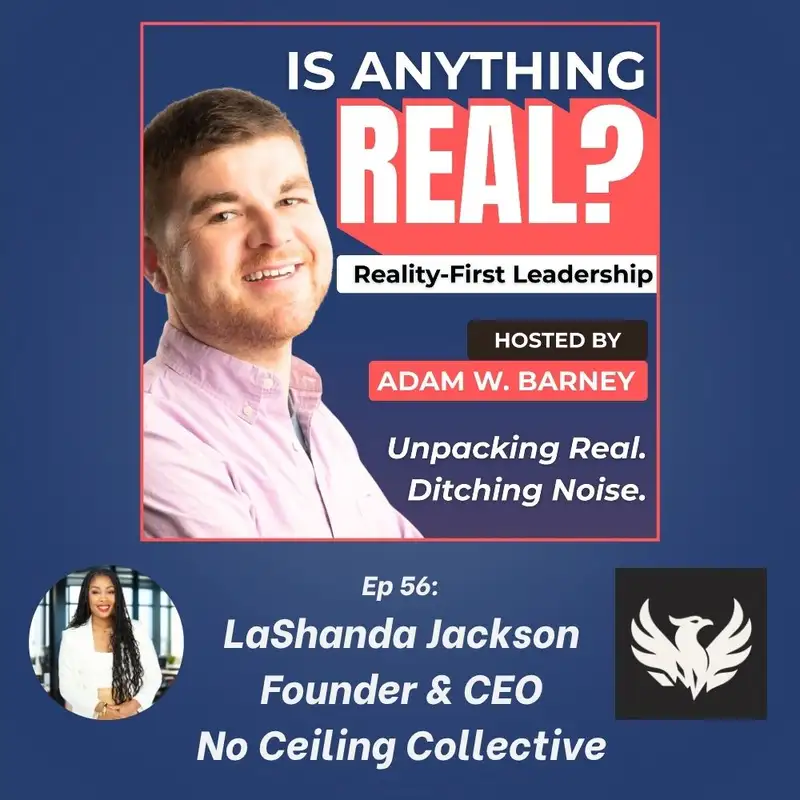
Representation Is Strategy: Equity, AI & Real Growth | Ep. 56 w/ LaShanda Jackson (No Ceiling Collective)
[00:05.6]
Advertising promises precision, but when the funnel itself is collapsing under AI, cookies are disappearing, and the representation is still an afterthought in too many agencies. What's actually real? Today, I'm joined by a leader who's challenging both the data and the diversity gaps in marketing.
[00:24.1]
Welcome back to Is Anything Real? And The show where we cut through the hype and get to the truth behind what really works. I'm Adam W. Barney, coach, author, and host of this growing podcast where leaders, marketers, and creators around the world join to share what's real and what's noise. LaShanda Jackson is a senior marketing executive, growth strategist, and global brand builder with deep expertise developing and executing pioneering experiential and life cycle initiatives.
[00:53.1]
Those are AI-driven across email, social automation, and digital transformation across the technology, CPG, and retail sectors. She's a respected alumna of premier organizations including HP, the Home Depot, and Intuit Mailchimp and has led groundbreaking campaigns that elevate brand awareness, promote industry recognition, boost customer engagement, and establish market leadership.
[01:18.7]
LaShanda has successfully led high-performing teams across diverse EMEA, ANZ, and North America markets and cultures and is a sought-after keynote speaker, panelist, and consultant at industry conferences and leadership events. She was featured on the Nasdaq billboard in Times Square as a 2024 marketer to watch and recognized on the Corporate Event Leaders Index.
[01:42.9]
LaShanda is the founder and CEO of No Ceiling Collective, a strategy-focused marketing agency specializing in brand, full funnel, and experiential marketing. She partners primarily with tech startups and midsize B2B companies, while also advising Fortune 500 brands and select direct-to-customer businesses on scaling through transformational marketing initiatives.
[02:07.6]
She's passionate about economic empowerment, emotional connection, and community building as a first-generation Eritrean American, and apologies if that didn't come across right, please correct me, LaShanda. She deeply values resilience, financial access, and storytelling.
[02:28.3]
All principles that drive her leadership style and her marketing philosophy. And she actively partners with organizations supporting small business growth, inclusion, and financial equity. LaShanda, welcome. Thank you so much, Adam, for that amazing introduction.
[02:46.2]
I want to know her. All right, LaShanda, let's kind of rock and roll here. You've said that AI isn't just changing tactics; it's compressing the funnel itself. What do you mean by that? Well, just, I mean, I just think about all of the changes that you know, have just, I mean, honestly like every day there's some latest innovation in AI and I just think about when I started my marketing career, we didn't have all the specialization, it was just digital marketing.
[03:20.5]
Right. And now, like with SEO, you know, everybody wanted to be SEO optimized. Right. And now in the age of AI, you people are going to places like, you know, ChatGPT, to ask it a question.
[03:41.6]
And so in the past you had an opportunity to build rapport with people. You know, like if they had an unmet need, they came across something, then they got familiarized with their brand and then they went from reading about your brand and doing some of their due diligence and research, there was this natural flow in cycle.
[04:02.9]
Now they're just asking these AI agents, or tools, a question and it's giving them a recommendation. And so when I say compress the funnel now is like, do you need to be SEO optimized?
[04:19.8]
Do you need to be AI optimized? Right. It's just fundamentally changing the game. And for something that may not necessarily have a lot of credibility, people are putting a lot of faith in the results that are coming back.
[04:35.1]
Yep. And I mean, I think where you're going here is awareness, consideration, and decision making all kind of collapse into one messy moment that makes it tough for marketers to measure what's actually working. In that lens, do you see AI as an equalizer for small businesses or is it just another emerging tool from the big players that they'll continue to dominate?
[05:01.3]
I mean, I think AI right now is just, it's a hot topic. Right. And it's very polarizing. But as someone who stepped away from my corporate career and started a marketing agency, I think it's a game-changer for small business.
[05:18.1]
Because you know, in the past, if you think of, I just think about my marketing budgets and how much money I was pouring into SEO content and just trying to figure out what is Google's algorithm change this week that is going to get us, you know, to the number one or you know, the top three spot right now.
[05:37.4]
You know, you can do other things to optimize where these AI agents can recommend your company that, you know, if you don't have extensive budgets, you still have an opportunity to still compete and play. So I, I look at it as a positive thing, but only if you are forward-thinking enough and willing to learn, you know, like how to not do what everybody else is doing and actually, take it a step further.
[06:09.0]
Right. It's almost like AI doesn't really change the ad buy necessarily. It changes the path to trust for the customers that we're trying to reach, especially as small businesses. Yeah. I mean like, it's just so, like as someone who loves like research insights, I just was really perplexed with the amount of trust that people have in the results that come back from these tools.
[06:35.1]
And I kid you not, like, I was ideating something and I, you know, I think it had like a, what do you call that? Like where it had like a moment, like where it just makes something up. Right. A hallucination.
[06:50.3]
That's what we call it, hallucination. Right. And I was like, I don't talk to environmentalists. Why did that come back? And just like for people, psychologically, they put so much trust in this. I'm like, wow, like this is interesting. And so if you think about human behavior, just naturally that has happened.
[07:11.0]
It's like, well, we need to start doing a better job of training these AI agents so that when they're recommending our companies, they have FAQs or different things so that when people are asking the questions, it knows, insert No Ceiling Collective.
[07:27.0]
No. Right, right. Well, and it's interesting, like I think just in the lens of kind of, you know, where your focus is, especially with what you're doing with No Ceiling Collective. You know, we have to worry about a bit of the diversity and the representation that comes through those AI tools.
[07:42.9]
But to widen the aperture there a little bit, it weaves into agency leadership. And I know you, you launched No Ceiling Collective with a clear mission: more diversity, and representation in client facing roles. What pushed you to start that? I think in the beginning, it was more so that I just felt like I was meant to do more.
[08:07.7]
And I had that gnawing pull in 2024, that I wasn't necessarily living in my purpose and having the level of impact that I wanted to have. And it's no knock on the company or any of the other things, but it's more.
[08:23.6]
So, I wanted to do more. And by starting the agency, it was a very interesting time because, you know, a lot of companies were doing mass layoffs. I was seeing like updates on LinkedIn or you know, just really sad stories of people who were phenomenally talented at what they did.
[08:49.4]
But unfortunately due to circumstances they were displaced. And I'm someone that really thrives on collaboration and partnerships and, you know, I am more of a strategy person, and, but I work really well with creatives, and I appreciate what they bring to the table.
[09:09.9]
And so I also saw a disproportionate number of people who are black and brown, they were impacted. And I think even in some of the recent, news, you're probably seeing, like, you know, I think it was a disproportionate number of black women that have been displaced.
[09:28.8]
So I can't say that I hadn't, you know, that that wasn't lost on me. And so when I talk about diversity, I look at that very, I think I look at that broadly, beyond just black and brown, but also women, and the LGBTQ community as well.
[09:47.6]
And so that really matters to me. And so if I see exceptional talent, I now recruit both sides. I'm not only looking for clients, I'm also looking for people who do something really great. So that when we do find opportunities to work with companies, we're coming from a very different angle, where we celebrate that diversity of thought and that natural curiosity and appreciation for cultural differences.
[10:18.0]
Right? And I mean, I think from both of our experiences across our corporate marketing careers, you know, we've both worked with million and billion dollar brands. It's interesting to come out of the other side of that and through, you know, your experience, I'd love to understand why that representation is not just a moral issue, let's say, but it's also a results issue for clients?
[10:42.8]
Well, like, I think about, you know, the jean wars. Like, you know, I think that was like the hot, you know, topic over the summer. Right? And, I think various people have given, their opinions on it. But I saw like, a segment from Marcus Collins who talks about culture and the role it plays.
[11:04.5]
And so, I just wonder, like, if companies like American Eagle or some of these other ones would have been in hot water had they had, you know, teams that were very diverse, not only in color, but also in size and shape and different things like that so that they could have maybe caught something or flagged it.
[11:29.5]
And I get it, like marketing sometimes, like, you want to be provocative, right? You know, people want to have the contrarian view and, you know, and there's some of those things that are just like, you weigh the pros and cons and you just want to be, you know, like something PR newsworthy.
[11:46.9]
I personally don't think that that was ever the intention for American Eagle. But ultimately that's what happened. And so when you surround yourself with people who have diverse perspectives and you appreciate and value that, you know, people feel much more comfortable to speak up and at least challenge it.
[12:09.1]
You know, Amazon has a value. What is it? Disagree and commit. At least if you've had the conversation and you created a space where people feel safe to share their thoughts, you can then make a decision and then you go on about your business. But I just wonder, like, I look and I see so many times that things happen and it's so, it's embarrassing for me for the company to see them go through these things that could have been very avoidable.
[12:37.6]
Yeah. And I mean, part of it gets into, you know, representation. It shouldn't be thought of as window dressing. It's really part of strategy. But then also I love how you weave in this sort of the thought around. If your team doesn't look like your market, your insights are broken, your strategy is broken.
[12:55.4]
That's a dangerous place to play. And I like double down on making them feel safe to speak. Speak up. That's the other part because I think it's psychological safety sometimes. Like, and I have been in rooms at times like where I didn't feel that way.
[13:13.8]
Right. But I still spoke up. I think that that's the difference is that, I would like to help. I have more of like a focus on, like, I don't want you to have this public embarrassment, so I'm going to say the things that should be said.
[13:31.7]
Right, right. I know. Also, LaShanda, you know, going back to your corporate career at Mailchimp, you leaned into first-party data strategies before most people saw that storm coming. You know, what worked best for you. And then, you know, how does that get into the idea of cookies depreciating, privacy rules changing, you know, what's the smartest way you see for agencies to create that value exchange with customers?
[13:56.0]
Having moved to first party data in your own career and then where things are heading. Yeah, like I think I mentioned at the beginning, like, I'm a marketing strategist. I love all of the marketing disciplines. But, you know, like, there was all that conversation around cookie deprecation and, you know, changes that were happening with Google and so it basically, you know, put the ad industry on like, like, how do we go about doing this?
[14:23.6]
The reality is we were doing marketing before all that stuff existed and we're going to do it after. But we started shifting towards like, you know, if you think about when people come to websites, you kind of inherently kind of knew who they were.
[14:40.4]
But then when those changes happen now, all of a sudden you got like 70-80% unknown. So by having events, it started actually with events. I didn't do events for the sake of doing events. I thought it was an opportunity to have a value exchange of like, hey, we have maybe some expertise or some knowledge that's going to help you, small business owner, with your marketing or with your email or whatever you can insert, whatever those topics are.
[15:13.1]
And when they went to register for the events, they were willing to share their information because there was something of value on the other side of that. And then for us, if they came back, we now could match that data. And now you are known. And I know that you're Adam Barney. Right.
[15:29.1]
In the past. And so now I don't have to market to you, with this peanut butter approach where the message doesn't land, we can't personalize what we're sending to you. Because at the end of the day, it's like people want to be seen.
[15:46.1]
Right. And appreciated and then you understand the problems that I'm facing and that you, I can trust you, that you can help me with that. So until you know who you talking to, that was going to inherently be a problem. And so that was why we started kind of moving towards, like, you know, more of like, webinar strategies during COVID, and then ultimately we started doing full, full edge conferences and things like that.
[16:11.4]
Yeah, I mean, it really gets down to this idea that trust is built by meeting people, meeting our customers where they are. Right. Yes. That human connection is really, like, I started in shopper marketing and I used to, like, just watch how people shopped.
[16:31.0]
And I just, like always, never really forgot the person behind, who I was actually trying to market to. And I, you know, and I still carry that forward in our agency and how we approach things.
[16:48.2]
So whether it's digital or it's physical, and we're doing an event, we never forget the person behind the work. Right, right. That's deeply, deeply important. And, you know, LaShanda, it's not the brands. The brands that win aren't the loudest.
[17:04.7]
Right. They're the ones that the customers know that are worth listening to. Yes. Awesome. Well, LaShanda, this has been incredibly powerful. You know, if there's one key takeaway for listeners, I think it's this. The future of marketing isn't about bigger budgets.
[17:19.8]
It's about building that trust, telling those authentic stories, and making sure the people at the table reflect the people in the market. LaShanda, where can folks find you, connect with you, and learn more about No Ceiling Collective? Well, I am very active on LinkedIn.
[17:37.6]
So if you go to LinkedIn, you know, definitely reach out. Follow me. Follow our agency, No Ceiling Collective. We're going to be doing some really amazing things this year, and we're looking for, you know, great people to partner with.
[17:53.7]
So if you do something exceptional, reach out. Awesome. Well, big thanks, you know, LaShanda. Everyone please feel free to connect with her on LinkedIn. Learn more at the No Ceiling Collective website. Links will be in the show notes. This has been "Is Anything Real?" I'm Adam W. Barney, and if you want to scale smarter, stay energized, and cut through the noise, follow this show wherever you get your podcasts and connect with me also on LinkedIn.
[18:20.4]
LaShanda, thank you. Thank you, Adam. I really appreciate you for having me on. Awesome. And until next time, keep your energy high, keep your ads honest, and remember, community compounds. Thank you, LaShanda. Thank you. Take care. Bye.
Creators and Guests