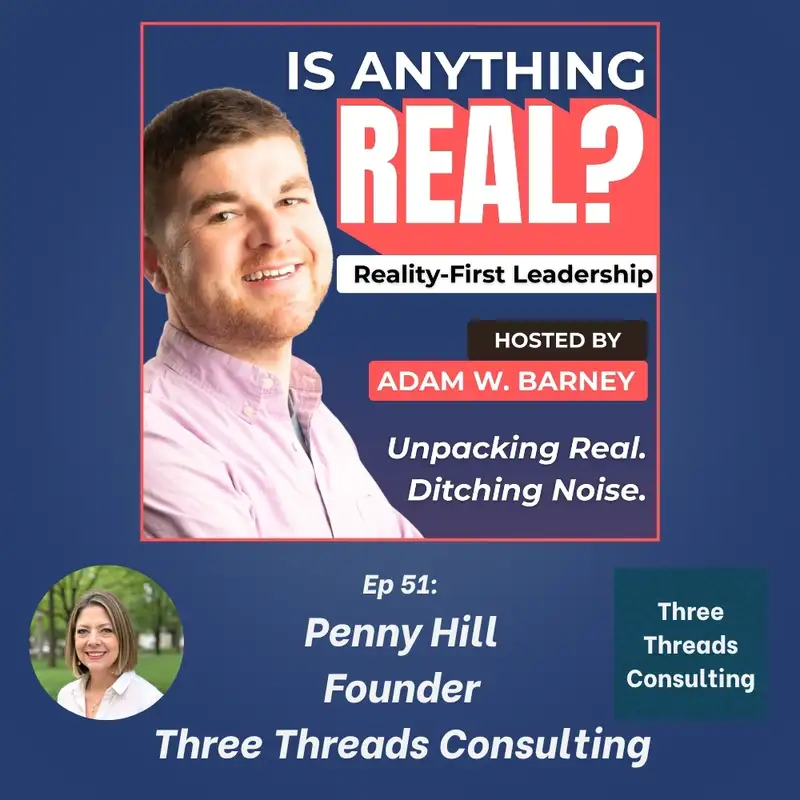
Paid Ads Are “Air Cover,” Not Pipeline | Ep. 51 w/ Penny Hill (Three Threads Consulting)
[00:06.2]
Welcome back to "Is Anything Real?", the show where we torch sacred cows and laugh at the dashboards that lie. Today's hot take: In 25 years of marketing, Penny Hill has never once seen paid ads drive direct revenue. Not a single time. Not once.
[00:23.5]
So if you're still treating Google or META like slot machines, let me ask you, how many quarters are you going to burn before you admit the machine is rigged? Penny just left the corporate CMO chair to launch Three Threads Consulting and she's bringing over two decades of hard truths about why paid rarely works, why ICPs get over engineered into oblivion, and why attribution is setting sales and marketing up like rival gangs instead of partners.
[00:51.0]
Penny, welcome to the show. Hey, thanks for having me. You've said flat out in 25 years you've never seen paid ads directly drive revenue. Walk me through that. Yeah, I've just never, I've never seen it.
[01:06.9]
You know, and the first time I thought maybe we were just doing it wrong. Maybe we didn't know what we were doing. It was, you know, with our targeting or maybe how we were executing on it. But as time as when, you know, went on and we've done it different ways, I've had different teams under me that's been executing on it.
[01:23.3]
You know, I still haven't seen it, I haven't seen that tied to direct revenue. Now that doesn't mean there isn't use for it out there, there does it? Doesn't mean there isn't a space for it. But if you're really trying to like generate a ton of ROI, on this, you know, this massive amount of spend you're feeding into it, you know, I don't see it in the B2B landscape.
[01:44.5]
So I mean, in the B2B landscape, what's the real role of paid ads? Is it simply brand surround sound, account based air cover, or is it even something else? Yeah, I mean I do see it as that kind of account based air cover, you know, just like you said, brand surround sound.
[01:59.9]
I think it's, I think it's useful to have out there. I think it's useful to have a part of your budget, a smaller piece of your budget in it, for sure, if you can be targeted with it, especially if you can target your key accounts. But that's, you know, a paid ad. I mean, that's not how people are buying today In the B2B landscape.
[02:19.4]
I mean, I think, you know, and our listeners know here, I spent $1,500 on Meta ads and and got zero leads. Yeah. Do you think that's just the norm we all need to admit out loud? Yeah, I mean, I really do. I do think that's the norm. And if the leads, and if you do get any leads.
[02:35.2]
But I have, I've found they're all junk. I mean, I'm pressed to say if I've ever seen a good one come through. For real, like a lot of them really are junk when they do come through in the end. And if you have a small marketing budget, it probably doesn't make sense to spend any money on it at all.
[02:53.9]
Like, you know, if you have a large budget. Yeah, yeah, maybe you can put some to it. But you know, even in my last role, I mean we eventually, we stopped it all together because it just, it just didn't make sense. Well, and so, you know, that's a great spot here. You know, to say if paid isn't the pipeline hero, what about the rest of the system?
[03:12.9]
Talk maybe a little bit about ICPs. You've said ICPs get so overcomplicated these days they can't even be operationalized. Why smart companies do this to themselves. Yeah, I think because a lot of times when we're looking at ICP, you've got a lot of people in the room making that decision.
[03:31.9]
You've got sales, you've got marketing, you've got product, you've got people that are executing, you've got the leaders, everyone's got a seat at the table a lot of times, everyone's opinion is valid. And yes, everyone's opinion is valid, but we also have to take a step back. So that's why I think the operations people, it's really important they're a part of it.
[03:49.3]
And think about, okay, yeah, here's our perfect world of everyone you want to be in your ICP and how you want to define it, but how can we actually operationalize it? Right. I mean there are just things we cannot see in the data. You know, working with different types of clients.
[04:05.6]
You know, and we can't see in the data easily. Right. Like it could be if you're working. Hospitality is an example. Like how many sites like the, like the hotel, the hotel has. That's not something you can always, you know, see in the data you don't have access to.
[04:22.1]
So it's going to be really hard for that to be an automated part of your ICP. So I think sometimes we get down this road where we have this very granular ICP defined and it's set, and it's approved, and it's a go. And then you hand it over to, you know, put it in your Salesforce to like flag your account.
[04:39.3]
And it's totally different because you have access to the data. And I think that gets in Penny, you know, to showcase in kind of the cost when every stakeholder gets an equal vote in defining a customer profile. How do you simplify an ICP so that it actually gets used successfully by not just marketing, but sales as well?
[05:01.2]
Yeah, I think you have to have, you have to have a strong, strong someone on the ops side that's, you know, that's actually going to put it in place that can kind of take it, take kind of what maybe the ideal is and start to piece together what is possible and what you lose, what you gain, from doing it.
[05:18.4]
Because at the end of the day, having an ICP flagged, I think in your CRM is vital and it's important even if it is not 100% exactly what your sales leader thinks it should be. If it's just a little, a hair broader, it's vital to have that, that tagged in there.
[05:34.8]
So we can, we, you know, we know who we're targeting. And so I think it is just leading those conversations. And always at the end, you do have to go back and have, you know, all the, at least the leaders sign off. Yeah. I mean, in that realm, you know, Penny, if you had to strip down, strip any ICP down to three data points, which ones would you see matter the most?
[05:55.8]
That might be a little difficult to answer, but where's the core? So I would, in general, I think, I know industries can be a little different, but in general, I would say your ICP keys are the industry. It's going to be a key part of your ICP.
[06:13.9]
Number of employees or revenue band, like something around there that's going to, going to tell you the size of the company. I think that's really, really important. And then depending on what you're doing, you could have some, you would, you could have another factor that's really important.
[06:30.0]
It could be, I've used like a telecom spend type factor, you know, in my past. It could be number of locations that they have or, just different factors. Factors like that number of call centers. Right. Or like how many employees are in marketing, maybe could be something that, that could be key for your ICP.
[06:48.7]
So I would say then there's like a third thing that's that. So I mean, I really think where we're going here Penny though, a good ICP is really a compass. It's not a novel. Right? So if your team can't act on it in under 60 seconds, let's say it's broken.
[07:06.3]
Yeah, yeah, yeah, for sure. Yeah. The other part I wanted to cover attribution models don't just suck, they create turf wars. Right? In that ecosystem, why do we keep building systems that pit sales and marketing against each other instead of collaboratively?
[07:24.3]
Yeah, I think it's. I know. I think at the end of the day it's because of ROI. Like everyone wants to know what is the return on the investment. And especially when you're looking at marketing, sometimes it can get a little finicky to really determine that like what direct revenue is tied to what marketing is doing.
[07:42.2]
And so, and I've done this so many times, so you end up having like dealer opportunity sourcing. Right? We have sales sourcing some, marketing sourcing some. It's a 100% made up model. Not that it's not helpful. Like, I mean, it's stuff I like to look at, but it is made up.
[07:58.4]
It's, you know, we don't know for sure. We're saying, well, you know, whatever touch, say six months before, this is what we're going to flag. And anytime you do that, then you're going to have like, sales is going to come up and be like, well, wait, but I actually did this or I did this. And it just causes that conflict, between them when they should be working together.
[08:17.7]
They're spending more time fighting over who really gets credit for the opportunity. At the end of the day, marketing doesn't create any opportunities. Sales is the one creating them. And I do feel that strongly. And you know, what marketing's doing is hopefully influencing all of them or a good portion of them.
[08:35.8]
And so that's the model I prefer to look at is like an as an influence model, like looking at the opportunity. What are all the touches? What has marketing done to help this move down the line? And look at real marketing. Don't look at an email click, or like, none of that matters if they open an email or click an email.
[08:52.3]
But like, what are they actually doing to interact, and respond, like truly respond to the marketing. And I mean, you know, I know you've seen this firsthand. I've seen it firsthand, where, you know, it turns into a battle of who owns the opportunity becomes more important than the closing.
[09:10.0]
And you just mentioned that. Right. Sales is responsible. But I think when we step back, isn't the real enemy the broken model, not necessarily the other team, right? Well, for sure, yeah. Yeah, for sure. It's the model. Yeah. It's not the team. Like, we all need to be working together because at the end of the day, the revenue, I mean, the revenue is for all of us. Right.
[09:29.1]
You know, it's important for the entire company. Yeah. You know, I'd love to hear an example and you know, you don't have to share anything that violates an NDA. What's the, let's say, dumbest attribution fight you've witnessed across your corporate career?
[09:49.9]
Oh, my goodness. Don't throw anyone under the bus. Don't burn any bridges. So I would say, well, I would say, and I think this, this will kind of show the results for it. So I've seen a model where marketing, was actually, was actually sourcing was, was called to source quite a bit.
[10:10.1]
And you know, this was part of how marketing was bonused and how, you know, marketing performance was tracked, was they had to source, you know, a significant amount of the pipeline. And so with that, they drove a kind of a lot of form fills.
[10:25.4]
They drove a lot of really quick nhit conversions over there with no care for quality. So it did not matter what happened to that. Yeah, just wanted to send it over. Right. And then what, what ended up happening in the end was a lot of this stuff wasn't high quality because it was from paid search ads.
[10:46.0]
Like it was. I mean, the sources, you know, were not driving what we really wanted, that none of the people were in the ICP. And so all of it, you know, goes to Closed Lost or I mean, the vast majority of it went to Closed Lost. So I would say that.
[11:01.4]
And that, you know, eventually turned into a fight when it was kind of realized, you know, like, hey, what's happening here? And sometimes it comes from valid places, you know, like sales is asking for leads and you've got some marketers like, okay, like, yeah, let me, let me give you more leads. And we just, we, we pivot and focus on that quantity instead of the quality that we're sending over.
[11:24.5]
Right, right. And then, you know, thinking, thinking as we plow ahead towards 2026. With multi-touch, long cycles, AI in the mix. Do you think attribution is salvageable or do we need to kind of kill it off potentially and rebuild from scratch?
[11:40.6]
I think it's salvageable. I don't think we kill it off. I think we just have to use it well. So, you know, I certainly love multi touch models. You know, I want to see all the touches. I'm kind of a data nerd though. Like, I want to see all of it, and can really get into the weeds with all of it. I think where we have to be careful is what are we showing, what are we putting to the executives, what are we putting up to the board, and what are we being measured on?
[12:03.7]
And when it comes to that, I don't know that attribution, like, I do think that kind of maybe should be thrown out, when it comes to, you know, actually driving, like, marketing goals. Well, you know what I mean? I mean, we do need to show that marketing is influencing it as a piece of the pipeline.
[12:19.7]
But that whole, like, who sources it, maybe, you know, maybe we keep it for sales, SDR partner, where it's. Where there's some pretty clean lines. That's it. Clean lines. That's important through all of this. Right. So, you know, shifting a gear here, you know, having just left a very deep bench of a corporate career for consulting, what's the freedom move you're most excited about with launching three Threads Consulting?
[12:45.1]
So I think it's being able to step in, step in and help companies. I think, you know, one of my superpowers is I can really untangle problems. I've seen, seen a lot, I've seen a lot of messes. And, and so to be able to come in and just kind of help you get through that hump or help you get through that project or maybe help you think about something a little differently with a different lens, and then get to do something different.
[13:10.4]
I know at this point in my career I'm really, really excited about just having that kind of more flexibility. So more, more flexibility, but also more impact, it sounds like. Right. It's not just about the flexibility. It's being able to zero in with these organizations that you help to more cleanly understand what that data looks like, what that performance, what that revenue looks like.
[13:33.7]
Yes. Yeah. And I think for sure, sometimes, and I saw it, you know, and when I was in the corporate world, when you have someone come in from the outside, sometimes they can, they can help maybe drive some of that change that people inside just can't. Just because, you know, just because of just the stuff that happens when we're there.
[13:49.9]
We don't always listen. We always listen to the people we're closest to. That's the beauty of, not in the marketing world, therapy. Right? And having that third party who can step in and give that extra perspective or open up the opportunity, but you hit the nail on the head.
[14:08.5]
It also gives you a license to come in and maybe be a little bit more pushy or a little spicier in the approach that you would take. And maybe it doesn't just hit a brick wall, it actually resonates with an organization. Yeah, that's right. Awesome. Well, Penny, this was rapid fire and intense.
[14:27.1]
But from calling out the false ROI of paid, to breaking down why ICPs and attribution are failing us, you've given the listeners here the crash course and what's actually broken. Where can folks find you and Three Threads Consulting?
[14:42.3]
You can find me on LinkedIn under Penny Hill. Awesome. And then finally, Penny for the marketer listening who's stuck in an organization where paid is worshiped, the ICP is a 50-page PDF, and sales and marketing are at war, what's the one move they should make this week to fix that?
[15:02.9]
I would say they, you have to bring, they have to find. Bring some real data to the table that shows why it's not working so we're paid, you know, show they're not driving anything. Or show maybe that all the, you know, all the leads coming through are getting disqualified. That, that's kind of a quick, easy thing.
[15:19.2]
You can look at it first, what's happening to them, when it comes to attribution, look at really what's happening, you know, like what's happening to the, the marketing source pipeline, for instance. And do it honestly. Like, do that even if you're in marketing. Right. Do that even if you're in sales. Like, look at really what's happening.
[15:36.0]
Because we don't get better if we're not. If we don't look at the reality, you know, as a company and as a team. Well, and it's also a bit, you know, not to dig too much into this ongoing war of sales versus marketing. It's just like we do with our customers. It's sitting in the shoes of the other side of the fence. Right?
[15:53.4]
It's understanding where sales is coming from as someone in marketing, or it's understanding the flip side of that, that's that's key. It's about communication, and it's about openness and evolution. Yeah, that's right. Yeah. Yeah. You know, I'm in marketing.
[16:09.2]
I've always been in marketing. I mean, sales is my biggest, like, customer. You know, a lot of times, like, they. They're who I'm working with. They're who I want to make happy. They're who's bringing the revenue for our company. So they're. They're really important. We need to think about it that way, not like that we're against them.
[16:24.8]
Right. Awesome. Well, thanks. Thanks for tuning into Is Anything Real where we shift signal from noise and torch the mirages this industry worships. I'm Adam W. Barney, and just a final thought here. If you're still praying to paid ads for revenue, you're not doing marketing.
[16:40.1]
You're gambling with shareholder money. Penny, thanks for joining us, and we'll see you next time. Yeah, thanks for having me.
Creators and Guests