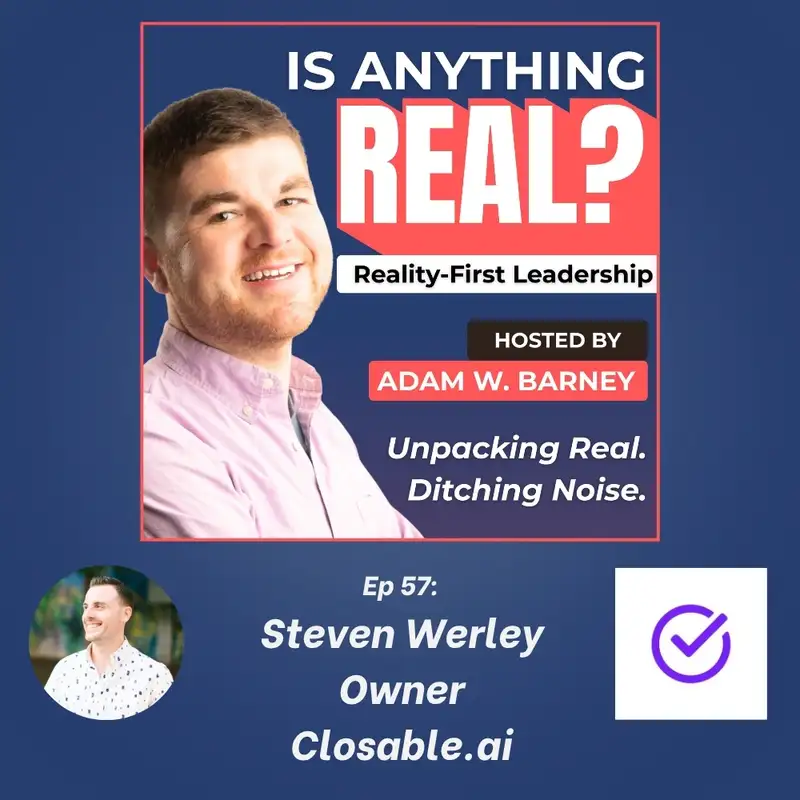
Deals Die in Follow-Up: How AI Saves the Sale | Ep. 57 w/ Steven Werley (Closable.ai)
[00:06.4]
Leads are easy, conversions are hard. But most ad campaigns die not just from bad clicks, but from what happens after the click. Today's guest has built AI systems that fix that fatal gap, turning ad dollars into real, repeatable revenue.
[00:22.9]
He's the mind behind Closable.ai, where sales enablement meets automation with a pulse. Let's talk about what's real in AI, sales, and human performance. Welcome back to "Is Anything Real?", the show where we cut through the noise, challenge the hype, and uncover what truly drives growth.
[00:40.5]
I'm Adam W. Barney, and today I'm joined by Steven Werley, founder of Closable.ai, a sales-side AI strategist who's built a career out of connecting what marketing promises to what sales actually delivers. We're digging into how AI is rewriting the rules of qualification, training, and conversion, and why the future of sales isn't just automated, it's energized.
[01:04.1]
Steven, welcome. Hey, thanks for having me on, Barney. Awesome. Adam. Sorry. There we go. Back to the middle school nickname. I'll take that middle school nickname. There we go. Look at that. Hey, we're starting off on the right foot. We are. You sure are.
[01:20.5]
Awesome. All right, Steven, you started on the marketing side before building AI-driven sales systems. Yes. What was the breaking point that made you shift from ad strategy to fixing what happens after the lead comes in? So I actually just started to really fall in love with the actual sales process and, you know, talking to folks and communicating.
[01:42.8]
And then when you would go away to the dungeon to do all the work or, you know, work with the team, that was, that was less like the fulfillment aspect of marketing. Not that I don't like fulfillment. I do. But the fulfillment aspect of marketing, I just, I just started to like less and less as it went on.
[02:02.1]
And I really started enjoying the sales process. So that's naturally how I just kind of fell into this position. Not bad. And I know you've mentioned to me your biggest bottleneck as an operator was training and follow-up, which really come down to human capacity.
[02:17.9]
How did AI become the solution to that? Yeah, so when I was running the sales agency, I had this, huge problem of just how I could train all these sales reps, and review calls, and give them proper follow-up and feedback.
[02:37.8]
So it came down to the point where I was like, well, it's time to start using AI. Right. And, I created a call review custom GPT. Took me some 30 plus hours with mentorship the first time.
[02:53.5]
Like, just really diving into AI. I have a background in computer science and stuff. So like I, you know, I've taken an AI class in college, like years and years ago before AI, you know, was what it is today. But you know, now that we're here, like you know, generative AI and whatnot, it required some refreshing learning of some new skills too.
[03:13.6]
So I did that, and, you know, instantly once I had that made, essentially not instantly, 30 plus hours later of work. And then I had a way to create a really strong follow up loop for the sales team where they could drop transcripts in and get feedback much faster than just, you know, waiting for me to review a call.
[03:35.8]
Which is really important when you're managing, you know, 10, 20 folks, or more than that. Right. Some people are responsible for a lot more than that. There's only so much time you have to dedicate to doing call reviews, and you should still do some of them manually, I believe. But now, if we can run everything through a way to get feedback, that's huge.
[03:58.7]
So that was one of the biggest things that I found to be incredibly helpful early on, when I started building out all these different systems that I have now. I mean I love Stephen, how most people these days and the way AI has evolved into our lives, dabble in it.
[04:14.9]
You've actually architected with it. Yeah, I can actually imagine, you know, in my time I spent a number of years working at Akamai Technologies, working with a lot of salespeople in a demand generation role. I can only imagine across a global sales team, how different that sales process was working in an organization like that.
[04:36.5]
Yeah. And actually, like here, how you know, you're getting into how AI at least has not yet replaced the salesperson. It's kind of replaced the excuses for lack of success or lack of alignment, I would say. Yeah, I think that's one great way to put it.
[04:54.4]
And it's enablement. Right? Like that's what it is. It's AI enablement within the sales process to help augment a salesperson, to like you said, perform better but you know, be more efficient and not forget, you know, certain things that you have to follow up on and things of that nature.
[05:14.3]
But also you know, level of just self- improvement, which you know, I think that's always existed. Like salespeople generally want to get better and do better. But again, like this is something that AI can help us do faster.
[05:31.1]
Yep. I think it would be funny in the future of Closable if you start having a having a quota attributed to Closable.ai, right? That would be, that would be incredible. But so many marketers I've seen over the years stop at the SQL and you live in what I've called the conversion canyon, where momentum dies or multiplies.
[05:52.2]
What really do you think happens in that gap? Yeah, I think there's a lot that, you know, there's this stage that we all put in our pipelines called follow-up, and that's where I think a lot of deals go to die. So, they live there, and they exist, and it, you know, like in Lion King becomes like the dark side.
[06:14.8]
You know, you just don't, you don't go to where the shadows are. Right. Don't go there, Simba. And, it's so difficult because, one, it's a relatively easy fix. It's not that it's that hard.
[06:29.9]
It's just that we're not doing simple things. So you know, AI aside, I think the one thing that anyone can do and if you're, you know, listening to this, and you're wondering what can I do? Like five minutes after the show, go on your CRM, add a next action item and next action date.
[06:46.9]
And if you do that for each deal and there's a reminder that pops up, you're good. I use AI to help assist with that aspect, which I think is huge. So the difference to me, you know, comes into a lot of people have the conversation and then it's like, okay, well now they need to make a decision, right?
[07:08.6]
I have a salesperson that's done my job, my job's completed in their heads, and they just need to make a decision, and it's like, oh, that person's never going to decide, or they're just going to ghost me, or you know, they're just price shopping or whatever the excuse is that we tell ourselves in sales, sometimes it's true, right?
[07:30.4]
I'm not saying none of the time it's not true. But we have the ability now to really analyze what happened in that sales conversation quickly, and create very unique type of assets and follow-ups to send off to these prospects to get them across the line or show that you know, we really care, and this is the huge human in the loop.
[07:52.7]
Let's use AI to augment, not replace, right? And when we do that, now all of a sudden we're outpacing what any other rep is doing in any other company, at least for a window here. Right. Like, in the future, this will change. But there's a window right now where I would say less than 10% of reps are doing this and probably significantly less than that.
[08:15.3]
It could be 1% of reps. I don't really know. I don't have a good data point, but I know for a fact that no way 10 in 100 are doing it, or 1 in 10 are doing it. So I would definitely say that, you know, in the follow up process, don't let deals die there.
[08:31.9]
Actually, have a plan of what we're going to follow up with and when we're going to follow up with them and what that looks like. So, that should always be a thing. I mean thinking about how you've trained and managed entire sales teams, I think there's also an advantage there, for when you're in an organization that has both like a setter and a BDR team, and then there's a handoff to an SDR team.
[08:56.1]
So much can be lost in that process. Right. In that sort of vein of that training and managing that you've done, how has AI really changed what great sales leadership looks like and how they guide those broader teams or even a small nimble team?
[09:13.8]
Yeah, so. Good question. Multiple angles that I could take. You know, I think just looking at the process overall now, and where AI comes in is especially when you talk about the BDR to SDR, and all of that.
[09:32.4]
There are so many great data points that we can get very quickly, on companies and organizations, unique people within an organization and how they make decisions and you know, is the company hiring for a certain thing and how many employees do they have, and revenue?
[09:49.3]
Blah, blah, blah, blah, blah. Right. So this data is so easily accessible now that it almost like can just easily transfer over instead of relying on like, you know, somebody doing research and trying to fill out notes and whatnot.
[10:04.5]
So they can almost just be fields now. And you know, I can even drop a summary in the notes. That makes it much easier for the handoff action to have. Yeah, exactly. And when you're looking at the comparison of a larger versus smaller team, I think it, it comes down to understanding.
[10:26.9]
And we talk about this in marketing a lot. I'm sure you have talked about it. It's like what got us here won't necessarily get us there. You know, what got us to six figures a month isn't what's going to get us to seven figures a month. Your six-to-seven-figure business isn't going to get us to an eight-figure, you know, business, nine-figure business.
[10:43.1]
So, it very similar with sales. When you are a smaller team, you have more ability to be quick and do more slight manual type of actions, and require a little bit more from someone.
[10:59.9]
But the second you start requiring those like, all those things from like you know, 30 people, or you know, even, even five people, like, it's like if you're requiring like all these BDRs, if you have five DDRs, start doing like all this like manual stuff, it starts to get really, really tough, in terms of getting them to follow a process.
[11:17.8]
So you, you have to systemize as you go. So you know, in the role of a smaller team, I would say the responsibility falls more on, hey, let's make sure we're just doing a process, right? And getting what we need to bring revenue through the door in a way that makes sense.
[11:35.3]
And then once that team's like starting to operate in a capacity that is positive, right? Like good revenue coming in, good profit lines, things of that nature, good close rates, all of that. Now where can I start to systemize this before we start growing?
[11:54.3]
And that's the difference, right? You need to get the strategy in place and then you have to start building the systems. And if you build the systems before the strategy, like, who knows that that system's gonna work for that sales team or that sales process and that industry.
[12:09.8]
So, I think you just have to be really knowledgeable of where it's at and make sure that you understand that first. Right. So it's like, hey, what can we do to lead success right now to get it down the line? Right. If you're already in a big team that's not performing, well, that's where things get a little bit more difficult.
[12:26.5]
But you can, you know, certainly start analyzing data at a high level to figure out where you can start getting the quick fixes and then rebuilding whatever needs to be rebuilt. Right. And I mean part of this also is, taking it a little further outside of just the sales lens.
[12:43.4]
You know, there's a handoff between marketing and sales. That shouldn't be a finish line. It's actually an opportunity. And I've always viewed it as a feedback loop. It should be a conversation that happens back and forth. You know, and AI systems come in. You know, I talk a lot about energy management, leaders protecting their capacity.
[13:02.9]
Where do you see human energy fitting into a sales process that's increasingly automated? Yeah, so human energy fitting. Can you just explain that question? I have an idea, but I want to make sure that I answer in the way that you're looking for here.
[13:19.7]
So, personal energy that we all have, even as salespeople, right? The energy that we bring to the table on a day-to-day basis, that's kind of what I mean. How does that human energy get amplified through using automation, or how does it help enable that human energy to come more clearly through in the sales process?
[13:41.5]
Right. So again, I think where we're at right now is no one's ready to be sold with AI. Maybe a very, very select few individuals would be willing to be sold by AI.
[13:56.9]
But most people still desire that human conversation. In a larger sale. Right. We're not talking to e-commerce here. Very importantly, AI can help.
[14:15.0]
Look at what we're saying. Look at what we're doing. Look at, what is the script for the VSL that somebody's seen before they come into the sales process. And then, how are those points being carried out through a sales conversation?
[14:30.5]
And are they aligned? Are they not aligned? Like what's happening there? And I think when you start thinking about like, hey, the human energy and the marketing to the sales side, if we start looking at all those things. Well, where I see AI helping the most in a situation like you're talking, it's being able to take large data sets and analyze them in a more objective manner, a lot more quickly.
[14:58.4]
So instead of, you know, trying to sit down and look at, you know, 20 calls and figure out what's going on here, like, why isn't this coming through? Is it the marketing side? Is it not? Well, the answer is always generally ambiguous to an extent.
[15:14.4]
There's always things that you can improve in every single part of the process. So I think where AI can come in is be more like hey, well one, closers aren't doing this, sales team's not doing this. Right. But also on the marketing side, like we're hinging a lot, on this hook in the VSL, but when they're getting on the sales call they're saying this, right.
[15:37.2]
So, it's a misalignment. And marketers know, they, they, you know, we talk about things like ad congruency. I'm sure I wouldn't normally bring this up and I know your audience, I'm sure is very familiar with it. If you think about ad congruency, what you're saying in the ad needs to match what you're doing on the landing page because generally speaking, that's going to lead to a higher conversion.
[15:59.6]
Well, that's just the same thing for marketing to sales. It's no different. And that's why it's not, it's not so much a handoff that is a continuation, like you said. Right, right. Well, and you know. I love how you help teams, with Closable.ai scale faster without losing authenticity.
[16:17.7]
How do you maintain trust when AI handles so many of the client interactions? So I use AI more to create what could be sent or what could be done, and less of a automatic, we're just going to send it.
[16:38.4]
Right. So it's less of a, hey, we're going to, you know, analyze this transcript and AI is going to send email. No, we're going to analyze a transcript. AI is going to draft an email, send it directly to the sales rep, and they're going to decide whether it needs to be edited, or whether it needs to be pushed forward.
[16:56.9]
And then also that's very important, from a couple of stances, not just to make sure that's aligned with what the prospect, or the offer, or any of those things. But you can't be a brain0dead sales rep when the person calls up, and you have no idea what they're talking about.
[17:15.9]
So you need to review these things, at least have a pulse on it a little bit. You know, even if it's not super fresh in your mind, you need to know what's being sent out. That's something that I think is just incredibly important, and especially when I talk about the enablement, this is a huge piece, the human needs to be there to be overlooking it.
[17:38.7]
So while I can make our work a lot faster, we're not drafting these custom emails, or doing some deep research that AI can do and we might be able to get an output and throw it in a Gamma page, or something to send off to the prospect fairly quickly. We can use AI to make our jobs a lot faster, and sell more like 60, 70% of the time versus 30% of the time, which is probably what a sales rep does right now.
[18:04.0]
I mean that's where AI can help predict intent. But only humans can really earn the true belief when they're going through that process. I know, also Steven, you've built Closable.ai to scale itself. What does momentum look like to you right now? I'm not sure I understand that one, Adam.
[18:24.2]
You mean just for me personally? Just the growth of Closable? Yeah. What are you learning from the business that gets applied to the clients these days? I mean, it's the same thing. So we practice what we preach. You know, I'm always experimenting, I'm always tinkering in the systems, and the tools, and the prompts behind what I'm using in the system.
[18:50.4]
I look at it in a way that I try to amplify myself in everything I do. But also, when I look at the sales team, there's still a gap. Right. Because to be fair, while I am a salesperson, most salespeople are a lot different than me in the fact that they are non-technical humans.
[19:15.8]
Right. It's just a fact of the matter. And I come from having a degree in computer science. I immediately am a little bit different in the way that I think and approach the back end to all of this stuff. But that was a hard learning curve for me.
[19:33.7]
So while I always tinker stuff on my own, I'm always hesitant in practice, what I'm doing with other sales teams. Because my goal is always how simple can I make it for a salesperson to become more effective.
[19:49.0]
And I used to have people go in different systems. Now we're, let's send them a Slack message, right? Like, let's use AI and integrations to send a Slack message instead of forcing them to log into some separate CRM to do stuff. So it just, let's simplify.
[20:06.1]
So, that's the difference, but also the similarities. I'm always trying to improve the system, how we're looking at it, types of responses, how we're training it, how we're taking all the conversation history into account when responding to a prospect. Things of that nature.
[20:23.2]
Yeah. In this lens of the future of sales isn't AI versus humans, it's AI for humans. Let's, you know, last question. Let's fast forward five years. What's one thing you think will still not be real in paid advertising or AI-driven sales?
[20:41.7]
What's something that won't be real? I will say, I still don't think we're gonna be ready for the robots to sell to us in general.
[20:57.2]
I just don't think it's gonna be there.
[21:03.5]
I mean, could you imagine, Adam, like, just like your automatic, like your phone, whatever it is, glasses. I don't know. Device without a screen, maybe that's just making decisions on your behalf every day of what you purchase and don't purchase.
[21:21.4]
And like, to an extent, like, I, I guess like the way that grocery stores order stock. But like, outside of that, like, in terms of our personal lives, I think that humans still got to be there.
[21:36.6]
Yeah. Maybe I'm wrong. I could be wrong on this. I'm very bullish on AI. I'm not bullish on people wanting to be sold by AI. I think there's going to be just too much skepticism throughout the whole thing. That's a great point.
[21:52.3]
You know, Steven, this was phenomenal. You're bridging a gap that every founder feels, but few can fix. Before we close, where can listeners find you and learn more about Closable.ai, and connect? Yeah, absolutely. So definitely feel free to connect with me on LinkedIn. Steven Werley there.
[22:07.7]
Steven's with a V, W E R L E Y. And also you can hit me up on my website closable.ai, and should be pretty much easy, those two spots. Easy to find me. And yeah, Adam, I appreciate you having me on. It was a great conversation. Awesome, Steven, What really hit me in this conversation is that the real ad optimization starts after the click.
[22:30.0]
AI can automate training, scoring, follow up, but it can't automate that energy we talked about, or that trust, or the curiosity. For sure. So, you know, Steven, paid ads might fill the funnel, but human energy still closes the deal, and that's what's real. Absolutely. Awesome.
[22:46.7]
Well, thanks for tuning into "Is Anything Real?". If this episode sparked ideas, share it, leave a review, and join us next week as we keep pulling back the curtain on what's real and growth, leadership, and the evolving world of AI. Until next time, plug in, power up, and keep finding what's real.
[23:02.2]
But Steven, thank you very much. Thank you.
Creators and Guests