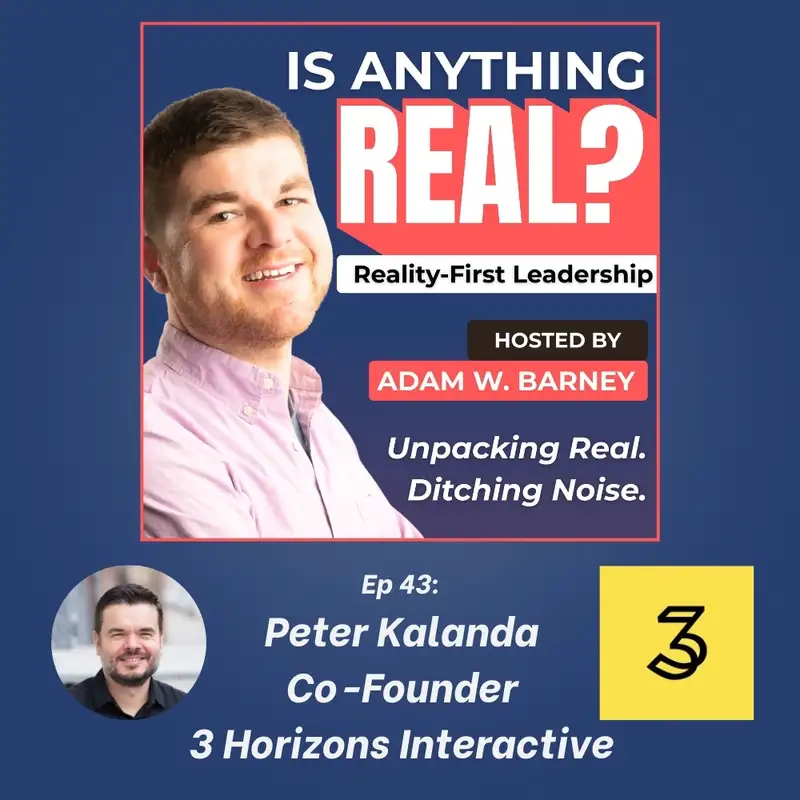
Always Be Testing: Real SEO/SEM Plays for 2026 | Ep. 43 w/ Peter Kalanda (3 Horizons Interactive)
[00:05.6]
Welcome back to "Is Anything Real?" The show where we cut through the noise, call out the mirages, and figure out whether your ad dollars are building equity or just evaporating in Mountain View's clout. Here's today's cold take, hot enough to burn: Ten years ago, $50 on Google Ads could build a business.
[00:24.8]
Today, that $50 barely buys you a latte and a CPM spike. So what's left? What's real? Joining me is Peter Kalanda, founder of 3 Horizons Interactive, whose career spans everything from managing a hotel in New York City to scaling a B2C business from $100k to $3 million.
[00:45.0]
And now running a full stack SEO, SEM, and web design shop. Peter, welcome to the show. Adam, great to be here. Looking forward to our conversation. Cool. Peter, your story starts in hospitality and finance and then takes a sharp turn into digital marketing.
[01:02.8]
Let's rewind. What pulled you from Ernst & Young to SEM dashboards? That's a good question. Yeah. So I started out in hospitality. I managed a hotel in New York City for quite a long time. A couple years. Started out at the front desk, working my way up, small hotel in New York City.
[01:24.4]
You know, learned a lot. You know, you learn a lot. It's customer service. It's all about experiences. And that goes the same thing with digital marketing. It's kind of, it's a good transition. I feel like, you know, when someone comes to a hotel, they check in, you know, they want to be treated well.
[01:43.4]
They want service from the money that they pay. And it's kind of the same thing with digital marketing. You pay a certain amount and you expect a result. The way that I got into it, you know, there was a couple of the, the company that worked for, at a couple of other hotels in, in Manhattan as well.
[02:02.5]
I kept in contact with one of the general managers, and he moved on and created one of the first booking engines for websites. So I came on, kind of helped out with the financial aspect of it. It was all hands on deck.
[02:17.7]
You know, a new agency that he started after he sold this booking engine company. Wow. It started out in hospitality, was kind of, was a good, good kind of entry point for me, and then kind of just learned everything with hands on, kind of making mistakes, you know, taking online courses, doing all that stuff.
[02:36.6]
And that's kind of how, how I got into it. You know, it was something that I felt like I could do and why not just give it a shot? You know, it's completely different. You know, I thought to myself, I always have that hospitality aspect to fall back on because, you know, you're always going to need a hotel, people are always going to be traveling.
[02:55.8]
Right. And it was great because it was in that hospitality field which was a great kind of entry point. That's fantastic. I mean, I have to say the non-linearity and so many, you know, careers within marketing is such an important part to set up the success in marketing.
[03:14.2]
Yeah. You know, and I know, up to where we are now, both of us have managed millions in ad spend, yet neither of us click ads. What do you think that says about the channel? You know, it's a great question. You're right.
[03:29.7]
I can't remember the last time I clicked an ad. You know, I usually just go to the organic result. And that's, you know, it's a quick question. I think it's just because we're so used to being in the back end, seeing the platforms and working within these tools that we just know where to go to and what we were looking for.
[03:56.0]
Sometimes, you know, you type a keyword and something else not completely not related to the search result pops up, which is a complete waste of spend for the client. And it might be a clue as to maybe the people who set up this ad or who are running this program for you are not the right people.
[04:18.2]
Or have you checked it? Do you go in and look and see what's going on in the site? Are you getting monthly, weekly reports? I think that's kind of like the biggest thing for me. I think when I type in a long tail or short keyword into Google and then I just see something that I don't like and I usually just scroll down and find the link that I'm actually looking for.
[04:44.0]
Interesting. I mean, in that realm is paid advertising from your perspective and the client work you're doing now more of a visibility tax than a conversion engine? Or is it still a valuable, valuable place to play? I think it depends on what you're bidding on.
[05:02.6]
If it's a certain keyword, it's high intent, you know, it's maybe longer than the generic hotel in New York City. You know, that's probably top of the funnel. If you're looking a hotel near Union, Square, or hotel near the Jacob Javits Center.
[05:19.2]
Maybe that's a little bit more targeted. So there's definitely still value, obviously, to paid advertising. It's a good entry point for someone who just started out, who has a new website. There's no authority score to it. It hasn't been around. It's a new URL.
[05:35.1]
Organically, it's going to take some time. But with paid, if you're targeted, if you know who you're targeting to, if you don't do a huge net, if it's targeted by zip code or location, then yeah, there's a potential to definitely bring in that user, put them in your funnel and convert them either right away or later on, and kind of nurture them through kind of different forms of advertising as well.
[05:58.9]
You know, I've seen plenty of times where an agency has, you know, bid on a word, and it's just targeted incorrectly, where it's just all of the United States and its, you know, you know, for example, like an ice cream shop in Vermont.
[06:16.7]
You know, why would you target California? And that's just because either they don't know or no one is checking it, or, you know, certain other things, but you just waste your budget like super quickly. And people have limited budgets. I've worked with people who have, you know, who just want to spend $2-$300 a month.
[06:34.3]
And you have to be super, super careful and targeted. Right. Because you could blow that thing in 20 minutes if you just do it the right way. If you're not careful. Right. And then there's still, there's still that impact. I know you've said, you know, SEO and SEM must work together, and I think you and I are in agreement there.
[06:53.4]
Why do you think so many businesses still silo that? I just think they just don't know, honestly. And I've been preaching that for so long, because they just work hand in hand. You know, if you don't have the right keywords, title, description, structure, data, all those technical things of SEO and then you're bidding on.
[07:17.6]
I'm going to use a plot. Pilates example, like Pilates. And that's a client that I have a Pilates studio in, you know, and where it could be anywhere, Manhattan. If you don't have that on as a keyword, obviously you're, you know, you're bidding on and then it's nowhere on the page that you're targeting and it's nowhere in the title, and the description in that URL, then, you're just wasting your money and people are probably outbidding you because it all kind of works hand in hand.
[07:48.6]
There's a. What are the things. I'm sure your listeners know a quality score. Right? Right. The higher the quality score, the better. Right. And now with, you know, there's a little bit change with performance max campaigns. It's a little different now. But yeah, those, those kind of technical and fundamentals are still true.
[08:08.7]
All these things kind of work together. I believe in the holistic kind of approach where it's, you know, social media, SEO, paid, kind of work hand in hand. Yep. Do you have any, any examples. Of course, you know, no NDA in place here, but of a simple landing page update you've made that outperformed maybe weeks or even months of paid media?
[08:34.0]
Yeah, I mean there's, you know, one of the ones that I do with clients. If it's a brick and mortar, and it's local SEO, localized, what we do is kind of make landing pages for different types of services.
[08:51.1]
For example, it's an accounting firm. Right. Or a lawyer, a personal injury lawyer in Orlando, Florida could create a landing page for that and not necessarily have to be on the site and visible by the user, but it'll bring visitors to your site because that page is out there and it's optimized.
[09:13.5]
You know, again, meta descriptions, title descriptions, the keyword is there. Images, alt text, content, FAQs, you know, it's all there. And you can redo that kind of landing page for multiple landing pages. Yep.
[09:29.5]
And it doesn't have to be part of your sitemap or not part of your menu. So you know, you're not going to have a drop-down with 50 different services and stuff like that. But that has worked great for multiple clients.
[09:45.5]
I mean, that's an incredible piece to bring up. You know, that's one of those foundations that I don't think gets talked about too frequently, even when you talk about huge clients spending a lot of money, is the value of what I've always thought of as marketing landing pages.
[10:01.6]
They don't sit in your central navigation, but they're essential for your customer on the customer journey or for filling a gap in that organic coverage. The content part of it is, you want to make sure you have a way to the customer to find you and, you could have that landing page, but I've seen a lot where people do that and there's no contact form or phone number or whatever it may be.
[10:28.3]
It just doesn't exist. So, you're getting the views. But then why am I not getting conversions? You know, stuff like that. And always test your contact form. Right. That I've seen where it doesn't go anywhere.
[10:44.0]
Don't just blindly believe that it's going to work when you set it up. Right. Test everything, have test accounts. I can't tell you how many times, with clients we've had where maybe you're talking more B2C specific, of course, but they don't have a test credit card to use.
[11:03.6]
Right. To even run a transaction, to go even deeper. Through the whole flow. Yeah. If it's a B2C client, you want to go through the whole thing where you actually get the package delivered also. And you want to do that a few times because sometimes, you know, these boxes come, and they're damaged and you don't know.
[11:24.0]
Right. There's a lot of testing. Is another. We could have another podcast conversation just about testing, I feel like. We used to call it in my early agency days ABT: always be testing. Right. It's an important thing. We should put that on a T-shirt.
[11:40.7]
Oh, man. You know, there you go. That said, when you inherit a new client, you know, in you work there at 3 Horizons, these days, what's the first fix you usually spot? The first fix I usually spot is... This rarely happens that much.
[11:57.8]
But the first thing that I look at, if you're indexable by Google, and there's been a couple of handful times where it's no index, the whole website, you're just not going to be found. Then the second thing is probably I just look at the home page.
[12:14.6]
Make sure that's structured correctly with the right headings and titles and descriptions. That's kind of what we work on first. And then what I said again with the contact. Right. Okay. Yeah. So there's three things we look at right away. Yeah. I mean, sort of, shifting gears, of course, you know, into more of the AI world and the future of human expertise.
[12:37.3]
You've mentioned, you know, how you've seen firsthand the way AI generated designs can mimic human work. Where do you draw the line between what I would say is impressive versus what's dangerous. Yeah. We had a client where we did an amazing design.
[12:57.9]
You know, he wasn't sure, at first he goes, why am I going to pay you guys to do design where I can just go into any of these LLMs and type in what I want, and it will get close to kind of what I want, what I want it to look. Yep.
[13:13.2]
But when he saw what an actual designer can do, he was blown away. So, the real person, the real real designer can still, is still important. Who knows how long that's going to last. I mean, these things are going to get so smart and be able to generate websites on the fly, probably.
[13:33.2]
Yep. But, you know, there's still there's still the part of it like who, you know, if, if who owns that content now. You know, is it the designer? Is it the people who want the website built, and if you throw it into XhatGPT and say, I want this design or this logo, you know, just make some variations so I could use it on another, on another parts of the website.
[14:01.2]
Should the designer get paid that or is it just because I already have the design, I paid for it? Right. Can I just repurpose it? And it gets pretty close. Honestly. We tested it with the design and it got pretty close to how it, how it was.
[14:16.3]
So it's it's a, it's a crazy space. LLMs is like the wild, wild west. Right. But I think, I still believe that the foundations and the core fundamentals of SEO and you know, want to make sure that you're being cognizant of LLMs and making sure you're the authority in the space, having FAQs on your site.
[14:39.0]
And almost at this point, we're advocating for FAQs on almost a lot more pages than usual. Oh, really? Interesting. That's a nuance there. That's fascinating. Yeah. But like a lot of the time, you have FAQs on our collections.
[14:54.8]
We have some FAQs on all our collection pages for a B2C client. Yep.
[15:03.8]
And that sort of ties to how we think about Google's SGE and AI-powered search. I think marketers probably view this as an entirely new channel. It sort of is, but it also sort of isn't.
[15:19.1]
There's a flipside to that coin. Yeah, it, it definitely. That's kind of where I've been kind of looking at it too, is like this is another channel. And you know, the latest item that I read was about two weeks ago that we have to teach clients to teach their users to use LLMs.
[15:39.2]
And you almost use it as branded search. Find us and use our keyword in these LLMs. It'll be able to get you what you want to see what your information, you know, kind of information. Right. Which is an interesting concept to go in and search based on the brand that you enjoy, you work with, or you're looking for.
[16:01.0]
Right. Yeah, it's kind of a cool approach, I think. That's a different way to look at it and I mean, I guess we could probably like play it forward a little bit. Yeah. You know, if we start seeing AI search eating both organic and paid clicks, where should agencies double down to keep clients ahead of the curve?
[16:19.1]
Yeah, it's, you know, right now it's, I mean, I think, I think, you know, SEO is obviously not dead. It's still organic, it's huge. Google's still the number one player, but it's slowly eating away. I mean, I'm getting, when I look at clients, analytical data, I see ChatGPT and Perplexity searches much, much more, you know, weekly, and daily.
[16:43.4]
You know, so you just want to be able to, you know, you just want to be, you know, you want to have that again. Like the whole LLM thing, you just want to have the foundations of SEO and if you have that there, you will appear in these search results.
[16:58.6]
And a great way to kind of do that is like if you go to your website, what would you want to know? What's the question you want to ask? If you ask that into ChatGPT, Perplexity, or any of these LLMs, you should have that question and answer on your website. That's a good point. Right. You know, what would you say the weirdest client expectation you've had to reset in any of these channels might have been, you know, whether it's paid or organic?
[17:25.5]
I want to show up, a hotel in New York City to a property that just opened and had a new website. You know, I want to appear for that term in two months, which is almost impossible.
[17:41.2]
You know, there's Marriott's, there are Hyatt's that been around forever. Yep. So you have to, you know, temper that expectation. Be like, you know, we will try to get you there, but we will do our best to get you in the long tail kind of aspect to it. You know, let's talk about your content, what kind of services you offer.
[18:00.6]
Post on social media. Make sure you're writing blogs and being out there. And what distinguishes the hotel is the best thing. I mean, you basically have to layer one brick on top of the other. You can't make the whole wall in one fell swoop.
[18:16.9]
Right. So it's being strategic about it. Exactly. Awesome, Peter. Well, this was a killer conversation. You know, it was incredible to go from SEO hacks into even AI trademark and attribution without missing a beat. Where can folks find more about what you're building at 3 Horizons Interactive?
[18:36.1]
Well, I'm actually, doing an offer right now where you can have a 15 minute audit of your site. You just put your name, email, and the URL: freesiteauditnow.com. Hit me up.
[18:51.7]
We can schedule a call, and I can give you three or four pointers that you yourself can implement without any technical implementation. And if there's more, you know, we can have a further conversation. But yeah, again, freesightauditnow.com.
[19:07.2]
And, you know, let's, let's work together. Let's fix your site and get it where you want it to be. And we'll have that linked below in the show notes for everyone here who's listening today. But thanks for tuning into "Is Anything Real?" The show where we sift the signal from the noise.
[19:22.4]
I'm Adam W Barney, and one last thing: if you're still throwing dollars into Google Ads like it's 2010, you're not buying growth, you're tipping the house. Let's rethink the funnel and let's future proof the strategy. But Peter, thank you for joining today.
[19:38.9]
Thank you, Adam.
Creators and Guests