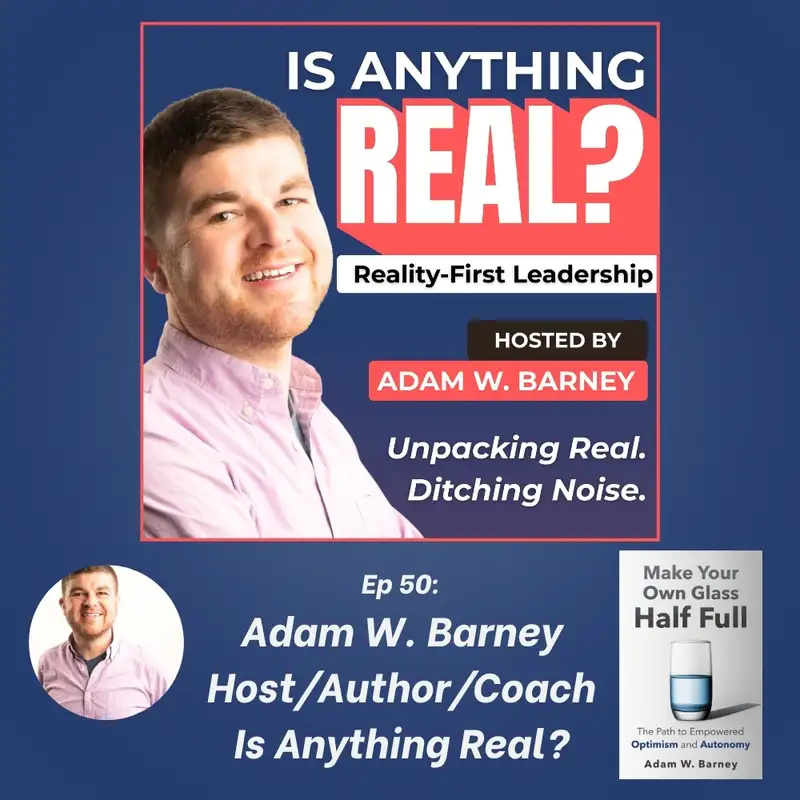
50 Episodes. 5 Truths. 1 Reality Filter. | Ep. 50 w/ Adam W. Barney
[00:05.7]
Most leadership content is performance. It's confident, it's polished, it's inspirational, and it falls apart the second real life shows up. And that's because constraints don't really care about your mindset. Constraints also don't care about your five-step framework.
[00:23.9]
And constraints don't care that you listen to a podcast at 1.7x speed. And now you know the play. Time. People. Money Attention. Energy. This is episode 50.
[00:39.2]
No guest, no fluff. Just what 50 conversations taught me about what's actually real and the filter I now use to cut noise and ship what works. And yes, I'm going to say a few things that just might make The Internet uncomfortable, but that's kind of the job.
[00:57.8]
Because if this show is anything, it's a permission slip to stop pretending. Welcome back to "Is Anything Real?", the reality-first leadership show, where operators test advice and publish the receipts so you can ship what works.
[01:13.2]
I'm Adam W. Barney, transition leadership coach for executives and founders, author, and host of this podcast. Now, episode 50 is a milestone, but it's also what I want to clearly call a pivot report, because the show didn't start here.
[01:30.0]
It actually started as "Is Anything Real in Paid Advertising?", And I'll keep it real, that wasn't a brand move. That was a personal crisis dressed up as content. I'd spent 20 years in corporate marketing. Big budgets, big orgs, big dashboards.
[01:48.0]
And then I ran a small Meta experiment for ads for my own practice. I threw about $1,500 at it, and I got nothing. No leads, no pipeline, no clarity, not even an obviously fake lead from a prince in a foreign country.
[02:07.0]
And what hit me wasn't Meta is broken. It was I'm asking the wrong question. This isn't mainly a marketing problem. It's a leadership problem. Because the question isn't what channel works, it's what works under constraint, when work and life get loud.
[02:24.1]
And honestly, that's how I ended up coaching. A lot of coaching lives in inspiration culture, pep talks, homework, borrowed frameworks. You feel good for 24 hours and then pressure spikes and you end up snapping back to old patterns.
[02:40.1]
I don't do hype. I do installation. Because motivation evaporates and systems compound. And the last 50 episodes didn't just give me interesting conversations. They gave me the same recurring truths from wildly different industries.
[02:58.0]
That's when I knew, okay, this show isn't about ads. It's about what's real. All right, let's get into it, and let's show some of the receipts here. Here's the true reality check I've learned the hard way: When reality is scarce, myths end up multiplying.
[03:16.6]
And Patty Civalleri, author of "Becoming Trader Joe", put that on a tee for me. Trader Joe's, as a brand, kept things close to the vest. So the public filled the gaps with mythology. Then the Internet started copying the mythology and calling it strategy.
[03:34.5]
And the reason that matters for you isn't Trader Joe's, it's this. That's exactly what happens in leadership. We don't have the full truth of what works. So, we borrow someone else's story, turn it into a doctrine, and then wonder why it collapses.
[03:52.3]
So today, we're going to replace myths with mechanisms. Because truth without execution is really just decoration. Now let's get into my own reality filter. Here's the filter I run everything through now.
[04:08.4]
Whether it's advice, tactics, leadership trends, every piece of it. The first is behavior. What's the actual behavior required? The second, the trade off. What does it cost? Is it time?
[04:23.7]
Reputation? Attention? Energy? Proof, then comes next. What outcome changes that isn't vanity. And then finally, it's about a constraint test. Does it still work when you're tired, understaffed, or under pressure?
[04:41.5]
Or accumulating what I like to call energy debt? Most advice fails at the behavior level. Or it works if you ignore the trade off or its vanity disguised as proof. Or maybe it only works in fantasyland where you have an infinite set of capacity.
[05:00.4]
So if it fails two of those, it's performance. But okay, let's get into five truths, and I'm naming guests so you can thank them, you can argue with them, and you can tag them when this goes live. The first truth: Clarity beats volume.
[05:20.1]
Nikhil Vaish and Pauline Schmiechen both hammered versions of the same thing. Most people don't have a growth problem. They have a clarity problem. They skip definition and jump straight to execution. In my coaching world, this shows up as leaders doing 30 things at once.
[05:38.4]
Because choosing one thing would disappoint someone. So here's the install. Define the one outcome you're optimizing for in the next 30 days. Then cut the activity that doesn't serve it. It's simple, but it's also not easy.
[05:56.4]
If your strategy needs a 48 slide deck to explain it, that's not strategy. That actually is a bedtime story. And nobody's sleeping. Especially not my two girls at home. Complexity is a hiding place. But simplicity is how you actually move.
[06:16.0]
Here's how I pick the one outcome. Because people always ask this, and then they overcomplicate it. I do a three-question sort. What's the most expensive problem right now? Not emotionally, financially, or operationally, but what's costing us the most?
[06:33.2]
Then it's what's the constraint? Is it decision speed? Team capacity? Clarity? Trust? Energy? A pipeline gap? Something is the bottleneck. And finally, what outcome would make everything else easier? Not perfect, just easier.
[06:51.3]
And then I turn it into a sentence that a tired person can still understand. In the next 30 days we are optimizing for X, by doing Y. Fill those gaps in. And we are explicitly not optimizing for Z.
[07:09.4]
Fill that final gap in. The last part is where the power is: naming what you're not doing. Because leadership is not choosing the best thing, it's choosing what you're willing to disappoint. Second truth here, trust compounds faster than tactics.
[07:29.0]
This truth came through loudest with Colin James Belyea and Chuck Garcia. Attribution is helpful. Worshipping it is a trap. People don't go click > buy like obedient robots. They research, they ask friends, they lurk, they look for unfiltered opinion.
[07:47.6]
So the real lever is building trust loops. Places where people can hear the truth, and see you show up consistently. In coaching terms, if you can't build trust, you can't lead. You can only manage. And I know, case in point across my own journey building this business and through my career, long-term relationships that compound over years beat short-term hacks.
[08:15.6]
And if you're running your company like a slot machine, pull that lever. Refresh the dashboard. Hope today is the day. Respectfully, we need an intervention. So, what does trust in terms of loops look like inside a leadership team?
[08:32.7]
Let me make trust loops concrete because it's easy to say, but it's hard to do. A trust loop inside a team looks like this. You surface reality early, you respond without punishment, you close the loop with action or a clear decision, and then you do it all again.
[08:51.5]
Most teams break that trust by doing one of these clear things. They ask for honesty and then get defensive. They collect feedback and then nothing actually changes. They say we're aligned when they mean we're avoiding conflict.
[09:07.6]
So here's a tiny operating move. Once a week, ask your team one question. What are we pretending not to know right now? And then your only job as a leader is to not punish the truth. That's trust. Truth number three that I've uncovered.
[09:24.9]
Energy is the constraint. This one is basically my life's work. And hearing it echoed back from guests truly made it hit harder. Sharon Hurley Hall said something that should end a lot of corporate nonsense. Resilience can become a weapon when it's used to demand more output from depleted people.
[09:46.7]
And Yasmine de Aranda helped widen that lens. If your leadership model only works for people without caregiving responsibilities, it's not leadership. It's a narrow operating system pretending it's universal. My coaching belief is blunt.
[10:04.5]
You can't outperform your energetic state. And burnout is really misalignment. It's not overwork. So we install rhythms that hold when things get loud, because that's when you actually need them. Resilience without reflection just becomes repetition.
[10:23.9]
So really, if your wellness strategy is a meditation app you use while your calendar commits violence against you, you're not solving the problem. That's a leadership gap right there. Here are three boundaries that actually work for high performers because they're simple enough to keep.
[10:43.9]
The no-meeting block that never moves. Pick one half day a week. Protect it like a client. That's your thinking and recovery space. The two yeses rule. Before you say yes to anything new, check, yes, it fits the one outcome, or yes, it fits your energetic capacity.
[11:07.8]
If you don't have two yeses, it's a no, or it just replaces something else. The last one here, recovery needs to be scheduled. It's not something you earn. You don't deserve rest after you hit a goal. Rest is the condition that actually makes goals achievable without breaking you.
[11:28.3]
And if that sounds soft, try operating without recovery for a year and tell me how strategic you end up feeling. Truth number four. Belonging starts with listening. This one came clearest with Alexander Michael Gittens and Christina Quinn.
[11:47.8]
Influence isn't just expertise; it's identity plus trust. And belonging isn't created by statements, it's created in moments. The simplest mechanism I heard: Repeat what you heard, ask if you heard it right, and then listen again.
[12:06.9]
And this is also straight from my coaching backbone. I meet people where they are, not where I am. That's not a slogan. That's not how trust gets built when stakes are high. Your team really doesn't actually need another off-site.
[12:24.2]
They need you to stop talking long enough to notice what's actually happening. And leadership is truly a master leadership skill. Truth number five. AI makes output cheap, and judgment ends up becoming the moat.
[12:42.4]
This came through strongest with Mike Tadasco and Steve Biegel. We're entering the era of infinite "pretty good". Which means the world is about to drown in content that's technically fine, yet it's spiritually empty.
[12:59.3]
So what's real? Judgment, character, and probably purpose that holds up under pressure. And one of my favorite lines from my own brand story is optimism is operational, not motivational.
[13:15.9]
It's not vibes. It's actually structure. Because in an AI world, your voice is the moat, your values are the moat, and your consistency is the moat. When creation gets cheap, judgment becomes priceless.
[13:32.7]
AI can also draft your content, but it cannot draft the integrity that you need to maintain. So there are a couple spaces here where I've actually changed my mind, and there are two updates I'm owning publicly. I used to think growth was mostly tactics.
[13:50.8]
Now I think it's mostly decision hygiene and trust loops. I used to think resilience was always the answer. Now I think resilience without recovery becomes extraction. And this is why my work is installation, not inspiration.
[14:08.6]
This is structural change that holds when things get loud, not homework that dissolves when your calendar fills back up. And yes, levity and grace aren't optional. The work you're doing is serious enough, you don't need to be.
[14:25.0]
Here's one move you can run this week. It only takes 20 minutes. I'm calling it The Reality Rewrite. Take one initiative you're running, whether it's a project, a strategy, whatever. Write four lines, fill in the gap at the end of these.
[14:42.7]
The first, the behavior required is ________, what? The second, the trade off is ________, fill that one in. Next third, the proof we want is ________, what's that? Get it. Under constraint, we still do ________, and we will stop doing ________.
[15:04.4]
And if you can't fill that out, you don't have a plan. You have activity. And this is why I coach transitions. When the old playbook stops working, you don't need more effort. You need a new operating rhythm. All right, before I hit you with the last question in this celebratory episode 50, I want to put a little skin in the game.
[15:26.4]
Because everything I'm talking about, clarity, systems, energy, truth under constraint, didn't come from a book. It came from getting my own teeth kicked in by life at a few key points. In college, I got suspended for a semester after a collaboration institute in my computer information systems program.
[15:47.1]
I could have stayed angry. Instead, I actually ended up in therapy for the first time. The first chapter in my life. And I learned something that stuck. Setbacks aren't failures. They're intentional pauses that force you to recalibrate.
[16:03.0]
That idea has been the through line of my whole life. Fast forward 20 years later, and I'm checking every box that looks like success from the outside. But I'd also watched too many leadership meetings where executives asked burned out teams what they needed and then did nothing meaningful with the answers.
[16:23.5]
About a year and a half into COVID, my wife and I took a three-day trip to Mexico, away from our two young girls, our dogs, and away from the noise. And the thing that changed everything wasn't some breakthrough strategy. It was simply space. The space created the clarity.
[16:43.5]
I realized staying would mean running harder and harder in a direction that wasn't mine. So I wrote my resignation letter on the plane home. No backup plan, just certainty. And here's why I'm telling you this in episode 50.
[16:59.2]
Because when people say, I don't know what to do next, most of the time they're not missing intelligence. They're missing space and truth. And that's what this podcast has become for me, too. A forced practice of truth, a forced practice of mechanism, and a forced practice of asking, okay, but what's real under constraint?
[17:22.7]
Clarity isn't a personality trait. It's a condition you actually create. So after 50 episodes, after all these receipts, after all these truth tests, I'm asking again, is anything real?
[17:40.4]
Well, of course, yeah. Some things are real. What's real is the moment you stop blaming yourself for a system problem and you start redesigning your life like an operator. What's real is that motivation fades and systems compound.
[17:56.4]
Not because it's trendy. Because it's biology. It's pressure. It's just a Tuesday. What's real is that you can't outperform your energetic state. If your operating rhythm depends on you being at 110% all the time, you don't have an operating system.
[18:15.1]
You have a slow motion breakdown. What's real is trust. It's the only thing I've seen that compounds across every industry, every role, every transition. And what's real is this: transitions are not detours.
[18:31.1]
They're the moment the old playbook stops working and you either get bitter or you recalibrate. So, yes, some things are real. And if you're in the middle of it, if things are loud, and you're tired, and you're not sure what's next. Here's the good news.
[18:47.4]
You don't need more hype. You need space, truth, and a system that holds when life gets loud. That's real. So if episode 50 hit you, send it to one leader who's addicted to performance and starving for proof.
[19:04.7]
And if you're leading through change and want a reality first reset. Of course, as always, there's a 20- minute clarity call linked in the show notes below. No pitch, just space to get honest about what's working, what's waste, and the one move to run next.
[19:23.7]
Until next time, it's been a pleasure, as always. Proof over performance. And ship what works. Thank you very much. I'm Adam W. Barney, and I'll see you again on "Is Anything Real?". That's 50 episodes. Thanks for being a part of the journey.
Creators and Guests